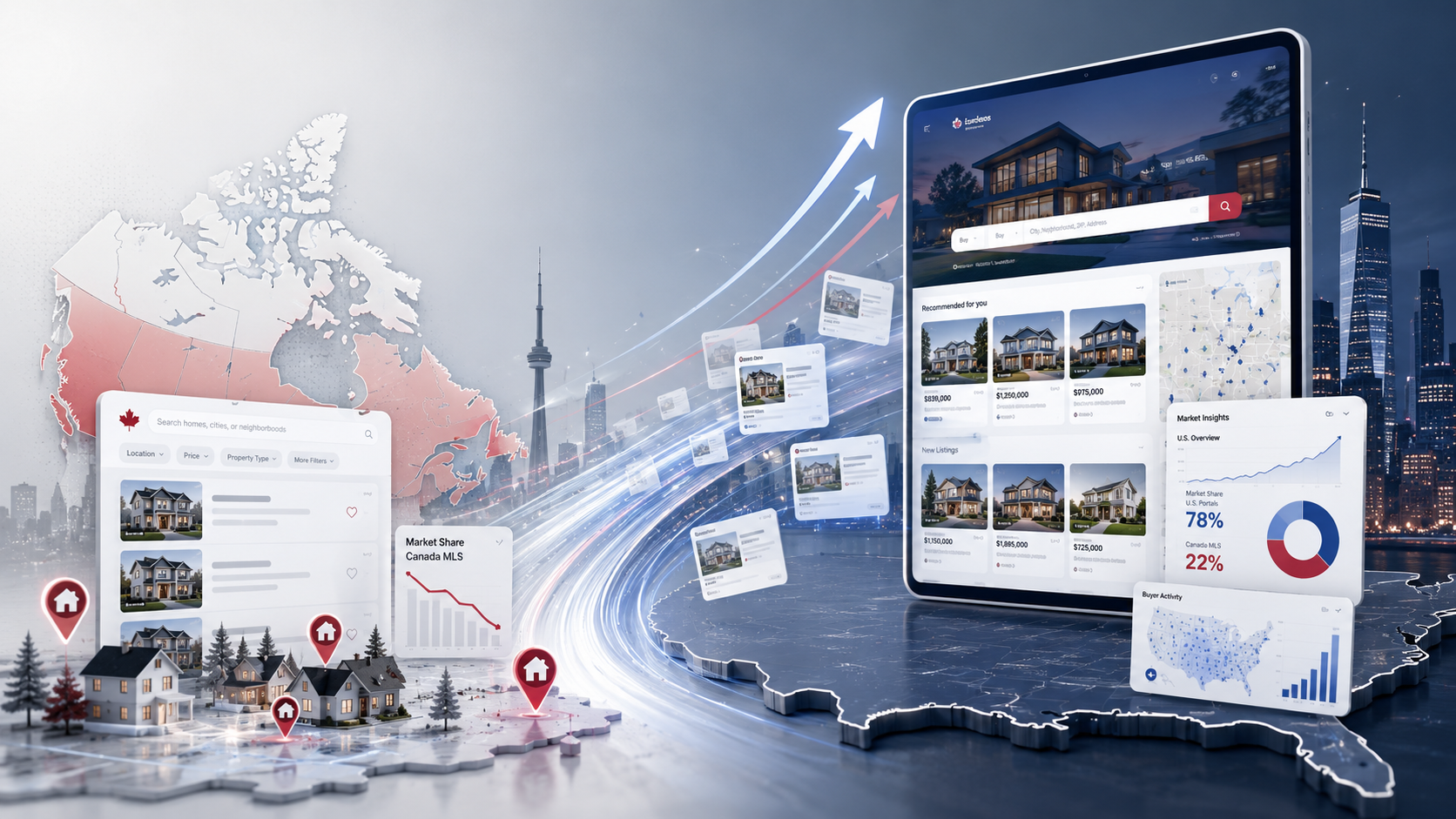
There's a conversation happening at every Canadian real estate board right now. Agents are frustrated that buyers arrive at showings having already done all their research — on Zillow. Not on the MLS. Not on the brokerage website. On a U.S. portal that doesn't even have accurate Canadian inventory.
This isn't about listings. Canadian boards and MLSs have the listings — in many cases, more accurate and more complete than anything a U.S. aggregator can scrape together across the border. The problem is everything around the listing.
The Data Buyers Actually Want
Spend ten minutes watching someone search for a home and you'll notice something: they spend as much time researching the neighbourhood as the property itself. They want to know what's within walking distance. They want to understand the demographic makeup of the area. They want to know if the school catchment is strong. They want to see what's been permitted on the property and whether there's anything that should raise a flag.
None of that information lives in a listing. It lives in data layers that need to be assembled from multiple sources and attached to the listing at query time. U.S. platforms have been building those data layers for a decade. Most Canadian platforms haven't started.
The gap isn't ambiguous. Here's a side-by-side of what a buyer sees when they look at the same Toronto property on a major U.S. portal versus the average Canadian MLS search portal:
| Data point | Major U.S. portal | Avg. Canadian MLS portal |
|---|---|---|
| Walkability / transit score | ✓ Shown | Rarely |
| Neighbourhood boundary + name | ✓ Interactive map | Rarely |
| Nearby schools with ratings | ✓ Shown | Occasionally |
| Points of interest within 1km | ✓ Shown | Rarely |
| Demographics for the area | ✓ Shown | Almost never |
| Permit history for the property | ✓ Shown in some markets | Almost never |
| Energy / utility cost estimates | ✓ Some markets | Almost never |
| Recent sales in neighbourhood | ✓ Shown | ✓ Shown |
The raw listing data — bedrooms, bathrooms, square footage, price — is roughly equivalent. The contextual data layer around the listing is not even close.
Why This Matters More Than Portal Loyalty
You might argue that Canadian buyers will use Canadian portals because that's where the accurate, board-verified listing data lives. That argument is getting weaker every year. Consumers have demonstrated consistently that they will gravitate toward whichever platform gives them the most useful information — even if that information is imperfect — because utility beats accuracy when the gap is small enough.
Zillow has made mistakes with Canadian data. But it has also shown Canadian buyers what a listing page can look like when data is layered properly. And once a buyer has seen that experience, the stripped-down version feels inadequate by comparison.
The more serious consequence is what this means for board and MLS revenue models. Portal eyeballs translate to agent leads, which translate to advertising revenue, technology subscription fees, and the political credibility that makes MLSs the authoritative centre of their local market. Losing that attention to a foreign portal isn't just a vanity metric — it hollows out the business case for MLS investment in technology.
What Enriched Listings Actually Look Like
The good news is that the data needed to close this gap exists. It's not hidden — it's a matter of connecting to the right APIs and surfacing the right information at the right moment in the search experience.
Consider what a fully enriched listing page for a property in Toronto's Annex neighbourhood looks like when Neighbourly data is attached. The listing shows not just the address and price, but:
- The neighbourhood name and boundary, resolved from the coordinate, with a walkability and transit index
- An address intelligence block showing the unit type, building vintage, canonical form, and Canada Post–validated delivery point
- A permit history section drawing on municipal open data, showing additions, renovations, and electrical upgrades filed under the address
- A points-of-interest summary — coffee shops, grocers, transit stops — calculated within 500m and 1km walking distance
- Demographic indicators for the census dissemination area: median household income, age distribution, population density, and language profile
- An energy profile showing modelled annual utility cost based on building vintage, unit size, and regional energy pricing
We've built a working demo of exactly this. You can see the full listing demo here — it's the same structure you'd ship to your buyers, built on Neighbourly's data layer, attached to a single Canadian address.
The Integration Question
One objection that comes up immediately: integrating a third-party data API into an MLS platform is not trivial. Boards have existing technology partners, existing IDX rules, and existing data governance obligations. A new data layer has to fit within all of that without breaking anything.
The integration pattern for Neighbourly is designed around this reality. You pass a Canadian address — or a coordinate — to the API and receive a structured JSON response containing all the data layers you've licensed. Your existing platform consumes the response and renders the fields you choose to show. There's no schema migration, no data warehouse project, and no dependency on the Neighbourly platform rendering anything in your UI.
Boards that want to enrich listings at search time can do so with a single API call per listing impression, adding under 100ms to page load. For boards operating at scale, the API is designed for bulk enrichment — you can pre-enrich your full listing inventory and store the output alongside your existing listing records, querying it without any additional latency at display time.
The Window Is Still Open — But Not Indefinitely
Canadian MLSs have a structural advantage that U.S. portals cannot replicate: verified, board-controlled listing data. The question is whether that advantage is enough on its own to sustain portal traffic, or whether it needs to be paired with the contextual data layer that modern buyers expect.
The platforms that move first on data enrichment will establish themselves as the primary search destination for Canadian real estate in their markets. The ones that wait are betting that listing exclusivity alone is enough — a bet that gets less safe every year as buyer behaviour evolves.
Closing the gap is a technical problem with a known solution. The bigger question is whether Canadian boards treat it as the strategic priority it actually is.