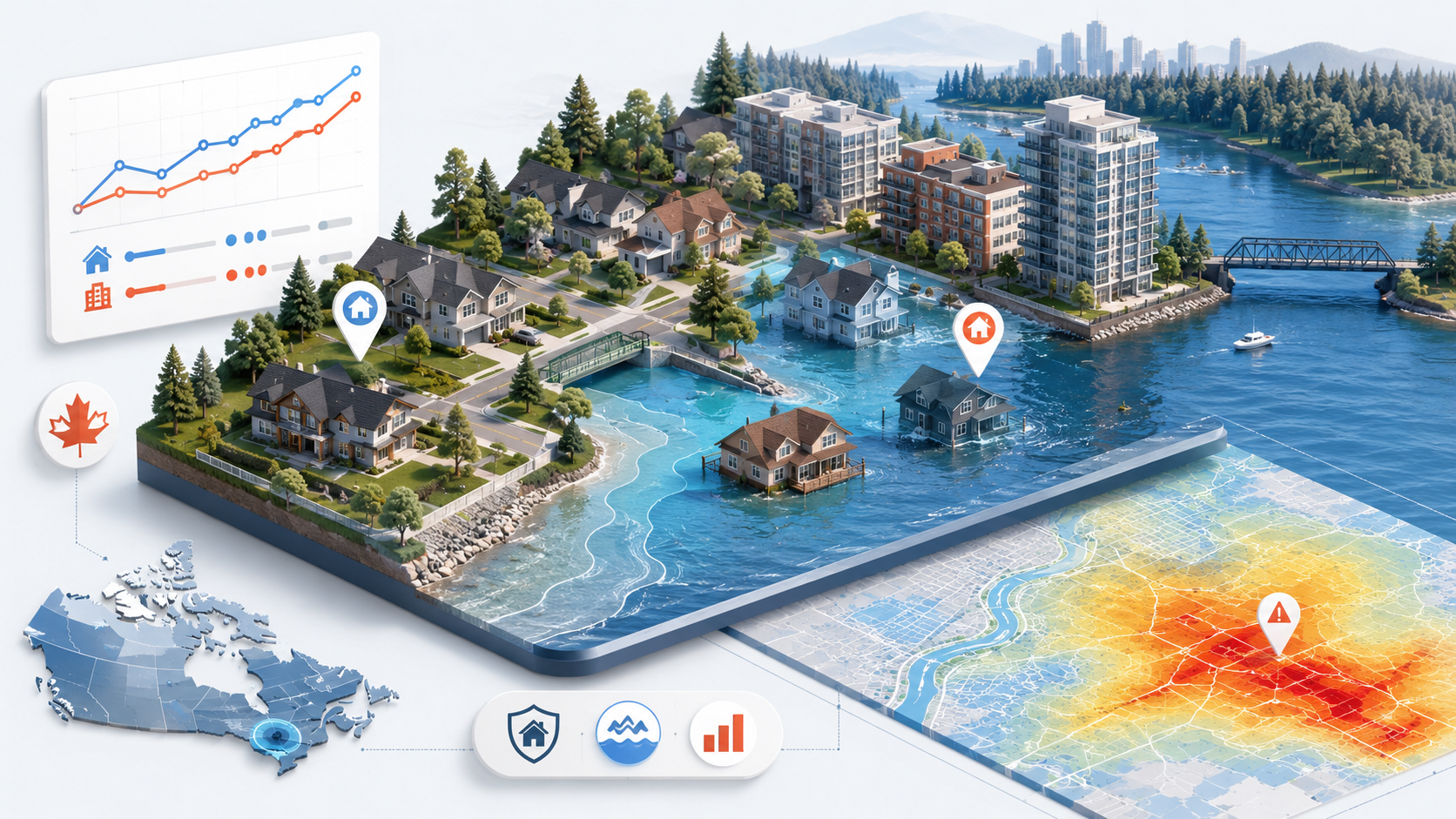
Canada is one of the most flood-exposed developed nations in the world. Roughly 1.7 million Canadian properties sit in flood-prone areas, according to federal estimates — and that number is growing as climate change intensifies rainfall events and accelerates snowmelt. Yet the majority of Canadian home buyers have no idea whether the property they're purchasing carries meaningful flood risk.
This is not primarily a matter of information being unavailable. It's a matter of information not being surfaced at the right moment in the buying process. By the time a buyer discovers flood risk — typically during a home inspection or through an insurance application — they may already be emotionally and financially committed to the purchase.
Why Flood Risk Is a Property Value Problem, Not Just an Insurance Problem
The conventional framing of flood risk focuses on insurance costs — and those costs are real and rising. Over the past decade, residential flood insurance premiums in high-risk Canadian areas have increased significantly as insurers have repriced risk in the wake of major flood events in Calgary, the Ottawa Valley, and coastal British Columbia.
But the property value implications are broader than insurance. Research from the United States — where flood disclosure is more mature — consistently shows that properties in FEMA-designated high-risk flood zones trade at a 4–10% discount to comparable properties outside those zones, all else being equal. As Canadian disclosure practices evolve toward American norms, similar discounting dynamics are likely to emerge.
There's also the mortgage question. Federal mortgage rules and lender risk appetite are slowly tightening around flood-prone properties. Properties in designated high-risk flood zones can face reduced maximum LTV ratios, higher rates, or in some cases, outright refusal from insured mortgage products. Buyers who don't know about flood risk before they make an offer can find themselves with financing complications after the fact.
The Data Gap in Canadian Flood Mapping
One of the foundational challenges in Canadian flood risk communication is that flood mapping is inconsistent and incomplete. Unlike the United States, where FEMA maintains a national flood map service that covers virtually all communities, Canadian flood mapping is a provincial and municipal responsibility — and coverage quality varies dramatically.
Some provinces, particularly Ontario and British Columbia, have relatively robust flood hazard identification programs. Others have significant gaps in coverage or rely on outdated mapping that doesn't reflect current climate conditions. For buyers researching properties in areas without good provincial mapping, the information vacuum is real.
Federal initiatives through Natural Resources Canada and Infrastructure Canada have been working to close this gap, and national flood risk models based on remote sensing and hydrological modelling now provide reasonably accurate estimates across the country. But this data is not yet consistently surfaced in the real estate transaction process.
What Flood Risk Data Actually Tells You
Understanding flood risk requires more than a binary "in a flood zone / not in a flood zone" answer. Meaningful flood risk data includes several distinct dimensions:
Return period probability
Flood risk is typically expressed as an annual probability of flooding. A "1-in-100 year" flood zone means there's a 1% probability of flooding in any given year — which translates to roughly a 26% chance of flooding over a 30-year mortgage term. A "1-in-20 year" zone carries a 71% probability over the same period. Buyers need to understand these probabilities in terms of their mortgage horizon, not just abstract return periods.
Flood type
Not all flooding is the same. Riverine flooding (from overflowing rivers and streams) behaves differently from surface water flooding (from intense rainfall exceeding drainage capacity) and coastal flooding (from storm surge and sea level rise). A property might be at low riverine flood risk but high surface water risk, depending on local drainage infrastructure. Complete environmental context requires data across all three flood types.
Relative elevation
Within a flood zone, elevation above the base flood elevation (BFE) matters enormously. A property that sits 0.5m above the BFE faces very different actual risk from one that sits 2m above it, even if both are technically within the same mapped flood zone. Elevation certificates and detailed terrain modelling provide this granularity where available.
| Flood zone designation | Annual probability | 30-year mortgage risk | Typical insurer response |
|---|---|---|---|
| 1-in-500 year zone | 0.2% | ~6% over 30 years | Standard coverage available |
| 1-in-200 year zone | 0.5% | ~14% over 30 years | Standard coverage, sometimes surcharge |
| 1-in-100 year zone | 1.0% | ~26% over 30 years | Surcharges or exclusions common |
| 1-in-20 year zone | 5.0% | ~71% over 30 years | Coverage may be limited or unavailable |
What Buyers Should Ask Before Closing
Given the current state of flood data availability in Canada, buyers who want to properly evaluate flood risk need to be proactive. Here are the questions that matter:
- Is the property within any provincially or municipally designated flood hazard area? Ask the listing agent and request the seller's property disclosure statement, where required by provincial law.
- What is the flood risk classification from national modelling? Federal and third-party flood risk datasets provide estimates where provincial mapping is incomplete.
- Has the property experienced flooding? This is a material fact that sellers are typically required to disclose, though enforcement varies by province.
- What will flood insurance cost? Get a binding quote before removing financing conditions — not just a ballpark. Some high-risk properties are effectively uninsurable for overland flooding.
- What is the municipality's flood mitigation posture? Some areas have significant flood mitigation infrastructure (berms, retention ponds, upgraded storm sewers) that meaningfully reduces effective risk. Others do not.
Environmental Data in the Listing Process
For real estate platforms, surfacing environmental risk data in the listing experience is both a buyer service and a liability mitigation strategy. Buyers who discover flood risk after closing — especially after a flood event — can bring complaints or legal action against agents and platforms they believe withheld or failed to surface material information.
The data layer for environmental risk — flood classification, air quality, proximity to hazards, climate indicators — is now accessible through APIs like Neighbourly's Environmental Data API. Attaching this to listings at query time doesn't require disclosing specific flood zones (which has legal complexity) but rather providing contextual environmental information that empowers buyers to ask the right questions and seek appropriate professional advice.
The Insurance Industry's Role in Repricing Risk
The insurance market is doing what regulatory mandates haven't yet achieved: pricing climate risk into real estate. As insurers withdraw from or reprice high-risk flood markets, the premium signal is beginning to affect property values in the same way that coastal insurance crises have affected values in Florida and Louisiana.
In parts of British Columbia, Alberta river valleys, and flood-prone Ontario communities, buyers are already encountering properties where flood insurance is either prohibitively expensive or unavailable from standard insurers. Properties that can't be insured can't be mortgaged under CMHC rules. Properties that can't be mortgaged are effectively limited to cash buyers — which dramatically reduces the buyer pool and suppresses prices.
This dynamic will intensify over the next decade. Climate projections consistently show more intense precipitation events across virtually all of Canada's major markets. The properties that are at risk today will be at greater risk in 2036 and 2046 — across the full term of a mortgage taken out today.
Buyers who understand flood risk before they buy are better positioned to price it into their offer, factor it into their long-term ownership calculus, and avoid the asymmetric information disadvantage that currently benefits sellers in markets where flood risk is not disclosed.