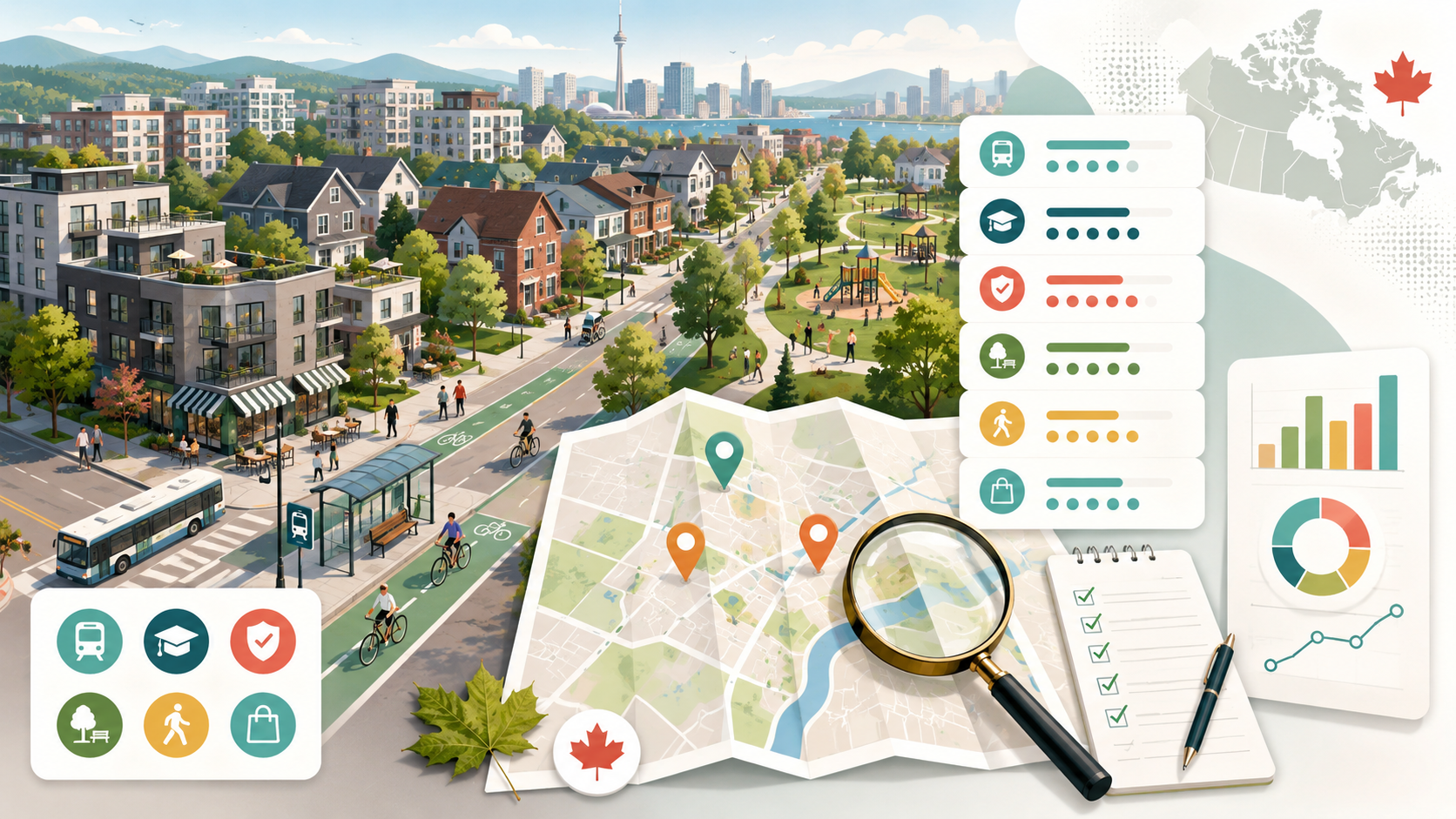
Buyers spend weeks comparing properties — number of bedrooms, finishes, garage size, lot dimensions — but often spend only a few hours thinking about the neighbourhood itself. This is backwards. A house can be renovated. A neighbourhood cannot.
The area you buy into will determine your daily commute, your children's school options, your access to green space, your exposure to environmental risk, and to a significant degree, the long-term value trajectory of your investment. Getting the neighbourhood right matters more than almost any feature of the property itself.
Yet most buyers rely on subjective impressions — a walk through on a Saturday morning, advice from friends, a vague sense of "up-and-coming" — when making this decision. There is a better way.
The Data Points That Actually Predict Fit
When researchers study what drives residential satisfaction — the actual lived experience of being happy in a neighbourhood — the same factors appear repeatedly. Understanding these factors before you buy is the foundation of a data-driven neighbourhood search.
Walkability and daily convenience
Walkability is the single most correlated predictor of residential satisfaction in Canadian urban areas. It's not just about being able to walk to a coffee shop — it's about whether your daily errands, your exercise, and your social life can happen without getting into a car. High walkability reduces car dependency, which reduces cost of living and stress.
Quantifying walkability requires knowing the actual mix of businesses, transit stops, parks, and services within walking distance of a given address — not just a single score, but a breakdown by category. A neighbourhood might score well on restaurant density but poorly on grocery access, which tells you something very different from a composite number.
School catchment quality
For families with children — or families planning to have them — school catchment is non-negotiable. But school catchment boundaries are not obvious from a map or a listing, and they change. You need to know which elementary and secondary schools serve a specific address, what those schools' ratings look like relative to the city average, and whether French immersion or other specialty programs are available.
This data is public, but dispersed across multiple provincial and municipal sources. A good schools data layer consolidates it and makes it queryable by address.
Demographic character
Demographics tell the story of who lives in an area — not to make value judgements, but to understand fit. A young professional moving to a new city wants to know if a neighbourhood skews young or old, whether households are primarily renters or owners, whether income levels are rising or declining. A family relocating from another province wants to understand language and community mix.
Statistics Canada's census data, at the dissemination area level, provides a detailed demographic profile for any Canadian neighbourhood. The challenge is connecting that data to a specific address and presenting it legibly. That's what a demographics API does.
Market trend and price trajectory
Not all neighbourhoods appreciate at the same rate. Some are in long-term decline; others are experiencing rapid gentrification; others are stable and mature. Understanding where a neighbourhood sits in its price cycle requires access to real estate transaction data at the hyper-local level — not city-wide averages, which can mask enormous variation across a metro area.
Look at median sold price per square foot over rolling 12-month periods. Look at days on market — a falling DOM indicates competitive demand. Look at the ratio of list price to sold price. These signals together tell you whether a neighbourhood is a buyer's or seller's market, and whether it has momentum.
Environmental risk exposure
With climate change making extreme weather events more frequent and more severe, environmental risk has become a first-order neighbourhood consideration. Flood risk is the most important factor for most Canadian buyers — even a low-probability flood event can cause catastrophic property damage and dramatically increase insurance costs.
But environmental risk goes beyond flooding. Proximity to industrial zones affects air quality. Wildland-urban interface locations carry wildfire risk in B.C. and Alberta. Urban heat island effects influence livability and cooling costs. A complete picture of neighbourhood environmental context requires data from multiple sources: FEMA-equivalent flood mapping, air quality monitoring, green space coverage, and proximity to environmental hazards.
Building permit history
Permit history for a specific property tells you what renovations, additions, or improvements have been done — and whether they were done legally. Unpermitted work is a serious liability in a real estate transaction: it may not be covered by insurance, it may fail a home inspection, and it may become the buyer's problem to remediate after closing.
At the neighbourhood level, permit activity tells you something about investment trajectory. Areas with high permit activity — lots of renovations, new construction, additions — are areas where owners are putting money into their properties. That's a positive signal for long-term value.
You can search any Canadian address for permit history through Neighbourly's one-off report, or access permit data at scale through the Building Permit API.
How to Structure a Neighbourhood Comparison
Once you know which data points matter, the next challenge is comparing multiple neighbourhoods systematically. Here's a framework that works well for Canadian buyers choosing between two or three areas:
- Walkability score and transit access within 500m of the subject property
- Grocery store, pharmacy, and primary care access within 1km walking distance
- Elementary and secondary school catchment — names, ratings, distance, and specialty programs
- Median household income trend (3-year), average age, and tenure split (own vs. rent)
- Flood risk classification and proximity to any environmental hazards
- 12-month and 36-month median price per sqft trend
- Days on market trend — rising or falling over the past 12 months
- Permit activity level for the street and immediate area — last 5 years
- Green space access — park area within 1km, tree canopy coverage
- Planned development or infrastructure projects in the area
Most of this data is available — the challenge is that it's dispersed across municipal, provincial, and federal sources, and accessing it requires significant time and technical skill. Platforms that aggregate this into a single addressable layer dramatically reduce the research burden on buyers.
The Neighbourhood Report as a Decision Tool
For buyers who want a complete picture of a specific area before committing, Neighbourly's Neighbourhood Report compiles all of this data into a single document for any Canadian address or area. For $99, you get a structured PDF covering demographics, market trends, livability scores, real estate activity, school data, business density, permit activity, and environmental context.
It's not a substitute for visiting a neighbourhood, talking to residents, or working with a local agent who knows the area deeply. But it gives you an objective data foundation to bring to those conversations — so you're asking better questions and comparing areas with consistent, quantifiable metrics rather than subjective impressions.
Agents: The Data Advantage in Buyer Consultations
For real estate agents, neighbourhood data is a competitive differentiator in buyer consultations. Buyers arrive at the first meeting having already done significant online research — but that research is typically shallow, drawn from general neighbourhood guides and portal tooltips rather than actual data.
An agent who can show a buyer a structured comparison of three candidate neighbourhoods — using real demographic, livability, and market data — is operating at a different level. It builds credibility, speeds the search process, and helps clients make a better-informed decision that they're less likely to regret.
Agents using Neighbourly's data layer in buyer consultations report that clients are more focused, make decisions faster, and are less likely to suffer buyer's remorse — because they made the choice with their eyes open.
The data to make those conversations happen is available. The question is whether you're using it.